
Understanding the Benefits of Using a Website Plan Mind Map
In website development, having a clear, organised plan is crucial to success. One effective tool to streamline this process is a mind map. A mind map visualises your website building plan, allowing you to brainstorm ideas, organise information, and create a cohesive structure.
Utilising a mind map during the website development process can break down complex concepts into manageable parts. A mind map lets you see the bigger picture while focusing on the finer details. A mind map with its interconnected branches and nodes encourages creativity and exploration, making it an invaluable tool for generating innovative ideas.
Not only does a mind map serve as an excellent brainstorming tool, but it also helps organise your thoughts and streamline the website development process. You can quickly identify gaps or redundancies in your content structure by visually mapping your ideas.
To make site navigation more accessible and improve the user experience, it’s vital to design a menu interface that is intuitive and user-friendly.
Furthermore, a mind map allows collaboration among team members involved in the website development. It provides a shared visual reference that promotes effective communication and ensures everyone is on the same page.
In conclusion, incorporating a mind map into your website development strategy offers numerous benefits. This powerful tool enhances efficiency and creativity throughout the web design process, from facilitating brainstorming sessions to organising information and fostering collaboration. Why not harness its potential to transform your next web project into something exceptional?
Step 1: Defining Your Goals and Objectives using Website Plan Mind Map
Using a mind map to identify website goals helps set website objectives. A map helps define navigation structure, target audience analysis, and competitor research.
A mind map helps start planning by visually defining your goals and objectives. By doing so, you can ensure your website aligns with your overall business strategy and effectively caters to your target audience’s needs.
One helpful tool in this process is a mind map. A mind map can help you visually organise and identify your website goals. It allows you to brainstorm and explore ideas, ensuring everything is obvious before making final decisions. By mapping out your goals, you can clarify what you want to achieve with your website.
Moreover, a mind map helps in setting specific objectives for your website. It helps break down broad goals into smaller, actionable steps. For instance, if one of your goals is to increase online sales, the mind map can help you define specific objectives, such as improving product descriptions or optimising the checkout process.
Additionally, a mind map also helps to define the navigation structure of your website. By visually mapping out your site’s different sections and pages, you can ensure an intuitive user experience and easy navigation for visitors.
Conducting a target audience analysis is essential to refining your goals and objectives further. Understanding your audience and target market helps you craft the content and design of your website specifically towards their preferences and needs.
Lastly, conducting competitor research can provide valuable insights into what works well in your industry or niche. Analysing competitor websites allows you to identify opportunities to differentiate yourself with a unique selling proposition.
You can lay down a solid structure and foundation for creating an effective website that meets business objectives and user expectations by utilising a mind map alongside target audience analysis and competitor research.
Step 2: Researching and Choosing the Right Platform
Regarding content management systems (CMS), WordPress is a top choice for many businesses. Its versatility and user-friendly interface make it an ideal platform for content marketing objectives.
The key benefit of using WordPress for content marketing is its vast array of plugins and themes. With thousands of options, you can easily customise your website to align with your brand and engage your target audience effectively.
WordPress also offers excellent search engine optimisation (SEO) capabilities. Its built-in features, such as customisable permalinks, meta tags, and XML sitemaps, help improve your website’s visibility in search engine results pages.
Furthermore, WordPress provides seamless integration with various social media platforms. A CMS allows you to effortlessly share information across different channel mixes to reach a wider audience.
Another advantage of using WordPress is its robust community support, which includes extensive documentation, forums, and tutorials that guide you in maximising the platform’s potential for your content marketing efforts.
In conclusion, if you choose WordPress as your CMS option, it offers numerous benefits that align perfectly with your content marketing objectives. Its flexibility, SEO capabilities, social media integration, and strong community support make WordPress an excellent choice for businesses looking to create impactful online experiences.
Creating a well-structured site with a user-friendly navigation flow ensures a positive user experience and maximises engagement. In this step, we will design an effective site structure and navigation flow that allows visitors to find the information they seek quickly.
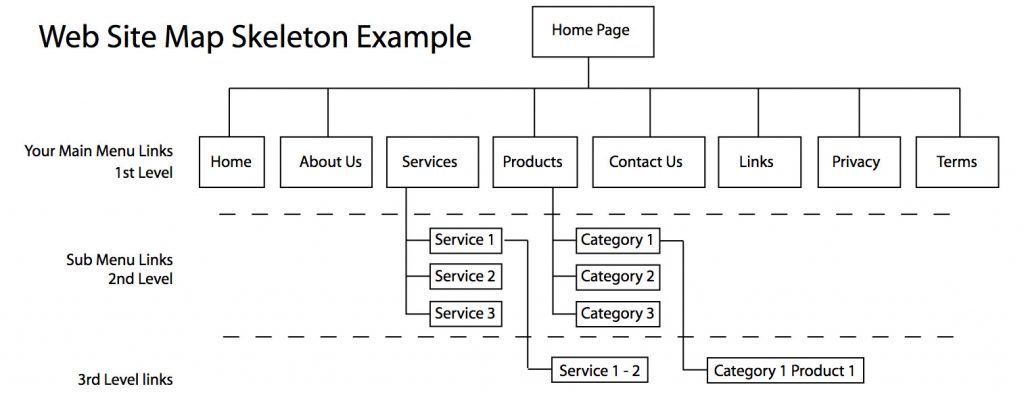
The first step in this process is creating a sitemap. A sitemap serves as a blueprint for your website, outlining the hierarchy and organisation of your content. By mapping out your site’s different sections and pages, you can ensure that information is logically organised and easily accessible.
Using a mind map makes designing the site structure and navigation flow easier by fast-tracking your thinking.
Designing a website can be complex, especially when it comes to structuring the site and planning its navigation flow. However, with the help of mind maps, this process becomes remarkably more straightforward and more efficient. A mind map lets you visually organise and connect the different elements of your website, enabling you to identify the most logical and intuitive navigation path for your users. By utilising a mind map in the design stage, you can save valuable time and energy while ensuring your website’s structure and navigation flow are user-friendly and seamless.
When organising your content hierarchy, it’s essential to consider both your target audience’s needs and search engine optimisation (SEO) best practices. Group related content under relevant categories or sections to make it intuitive for users to navigate your site.
In addition to structuring your content effectively, designing a user-friendly navigation system is essential. A straightforward, intuitive navigation menu helps visitors quickly understand where they are on your site and how to reach other sections or pages. To enhance usability, consider using dropdown menus, breadcrumbs, or search bars more extensively.
By creating a well-structured site with an intuitive navigation flow, you can ensure visitors have a seamless browsing experience while effectively showcasing your content. This step lays the foundation for an engaging website that keeps users coming back for more.
Step 4: Designing the Visual Elements
When designing a website’s visual elements, several crucial factors should be considered. From website layout choices to colour scheme selection, font choices, and logo design considerations, each decision plays a significant role in creating an impactful, visually appealing website.
Firstly, layout choices need careful consideration to ensure optimal user experience. The site layout must be intuitive and easy to navigate, allowing visitors to find information effortlessly. Consider the content hierarchy and strategically place critical elements such as menus, search bars, and call-to-action buttons.
Next, selecting an appropriate colour scheme is essential in establishing the desired brand identity and evoking specific emotions. Different colours have different psychological effects on users, so choosing colours that align with the brand’s message and target audience is essential. A well-chosen colour scheme can enhance user engagement and create a memorable visual experience.
Font choices also play a crucial role in conveying the right tone and enhancing readability. Selecting legible fonts across different devices ensures a seamless user experience. Additionally, fonts should align with the overall branding strategy while maintaining readability across various screen sizes.
Lastly, logo design considerations are vital for creating a solid brand identity. The logo visually represents the company or brand and should accurately reflect its values and mission. It’s essential to consider factors such as simplicity, versatility (for different platforms), scalability (for various sizes), and uniqueness when designing an effective logo.
By carefully considering these elements during the design process, you can create visually stunning websites that effectively communicate your brand’s message while providing an exceptional user experience.
Step 5: Content Creation and Copywriting Strategy
Writing compelling website content is crucial for attracting and engaging your target audience. In today’s digital landscape, effective copywriting is about crafting persuasive messages and incorporating SEO best practices to maximise visibility and drive lead generation.
When creating website content, it is vital to understand your audience’s needs and pain points.
You can customise your copy to resonate with your target market by conducting thorough research and utilising customer personas.
The research will help you build a strong connection with your readers and increase your chances of generating leads.
Incorporating SEO optimisation techniques into your copywriting strategy is equally important. You can dramatically improve your website’s search engine rankings by conducting prior keyword research and strategically placing relevant keywords throughout your content.
Writing content that builds on prior research will help potential customers find you online when searching for related products or services.
Furthermore, integrating captivating headlines, subheadings, and bullet points will increase the readability of your content while effectively conveying key messages.
Visitors are kept engaged and encouraged to explore further.
Remember that copywriting for lead generation goes beyond simply writing persuasive text; it requires a strategic approach that combines compelling storytelling with SEO best practices. By following these guidelines in step 5 of your content creation process, you can create impactful website content that drives traffic, generates leads, and boosts conversions.
Step 6: Integrating Relevant Functionality and Tools
It is crucial to integrate relevant functionalities and tools to create a fully functional and optimised website. This step ensures that your website meets the needs of your target audience and performs well in search engine optimisation (SEO) and analytics.
A critical aspect of integrating functionality is e-commerce integration, especially if running an online store. You can seamlessly integrate e-commerce features into your website, such as shopping carts, payment gateways, and inventory management systems, to provide customers with a smooth, convenient shopping experience.
Additionally, incorporating SEO plugins such as RankMath or Yoast will enhance visibility on search engine results pages. These plugins offer valuable optimisation features such as keyword analysis, meta tag customisation, XML sitemap generation, and more. By utilising these tools effectively, you improve your site’s search engine ranking and attract more organic traffic.
Furthermore, analytics tools like Google Analytics play a vital role in understanding your website’s performance. By tracking key metrics such as visitor demographics, page visits, bounce rates, and conversion rates, you can make valuable observations, gain insights into user behaviour, and make data-driven decisions to further optimise your website.
Integrating these relevant functionalities and tools ensures your website has the necessary features to meet user expectations while also maximising its potential for SEO performance and analytics tracking.
Step 7: Testing and Quality Assurance – Ensuring a Flawless User Experience
In today’s digital landscape, where user experience is paramount, testing and quality assurance are crucial to the success of any website or application. This step ensures that your website is visually appealing and performs optimally across different platforms and devices.
A critical aspect of web core speed testing is the increasing emphasis on page load times; ensuring pages load quickly and efficiently is essential. Conduct thorough speed tests to identify bottlenecks and performance issues that hinder the user experience.
These speed tests help you make the necessary optimisations and deliver a fast-loading website that engages visitors.
Another critical aspect of testing is cross-browser compatibility. With numerous browsers available, ensuring your website functions seamlessly across all major browsers, such as Chrome, Firefox, Safari, and Internet Explorer, is vital. By conducting comprehensive cross-browser compatibility tests, you can identify any inconsistencies or layout issues and address them promptly.
In addition to cross-browser compatibility, mobile responsiveness testing has become increasingly important as mobile browsing has grown. With a significant portion of internet traffic coming from mobile devices, ensuring that your website adapts seamlessly to different screen sizes and resolutions is crucial.
By rigorously testing your site’s responsiveness on various mobile devices and platforms, you can guarantee an optimal user experience for all visitors.
By incorporating web core speed testing, cross-browser compatibility testing, and mobile responsiveness testing into your quality assurance process, you are taking proactive steps towards delivering a flawless user experience. Investing time in these areas will improve customer satisfaction, increase online visibility, and boost the overall success of your digital presence.
Explore an EASIEST way to mind map online with bubbl.us
Check out the online Mind Map App =>> Bubbl
- Easy to organise your ideas visually,
- Makes sense of your goals and objectives visually,
- Brainstorm new ideas on the fly.